Have you ever been in the middle of a fast-paced texting session when a three-letter acronym suddenly brings the conversation to a grinding halt? You stare at your phone screen, trying to parse the sender’s tone, but the initials refuse to give up their secrets.
Language is shifting beneath our feet every single day, giving rise to an entirely new digital vocabulary. When someone drops “isk” into your chat box, it carries a very specific, quiet weight that completely alters the emotional landscape of your conversation.
Understanding these subtle textual cues isn’t just a matter of keeping up with internet trends; it is about building genuine empathy. By decoding these hidden shorthand patterns, you can instantly save yourself hours of anxious overthinking and misaligned expectations.
The Subtle Art of Shorthand: Why Modern Chat Keeps Us Guessing
The way we interact in digital spaces has evolved far past simple, functional message updates. Texting has transformed into an intricate psychological environment where brevity often collides directly with emotional expression.
People frequently search for online acronyms because a single misinterpreted word can fracture a fragile connection. Missing a conversational pivot can cause awkward standoffs, accidental ghosting, or lingering insecurities between close friends.
When we take the time to unmask these digital phrases, we inject real human warmth back into cold, mechanical glass screens. This comprehensive guide will dissect a highly nuanced, trending piece of chat terminology to help you browse your daily messages with absolute certainty.
ISK Meaning in Chat – A Quick Reference Meaning
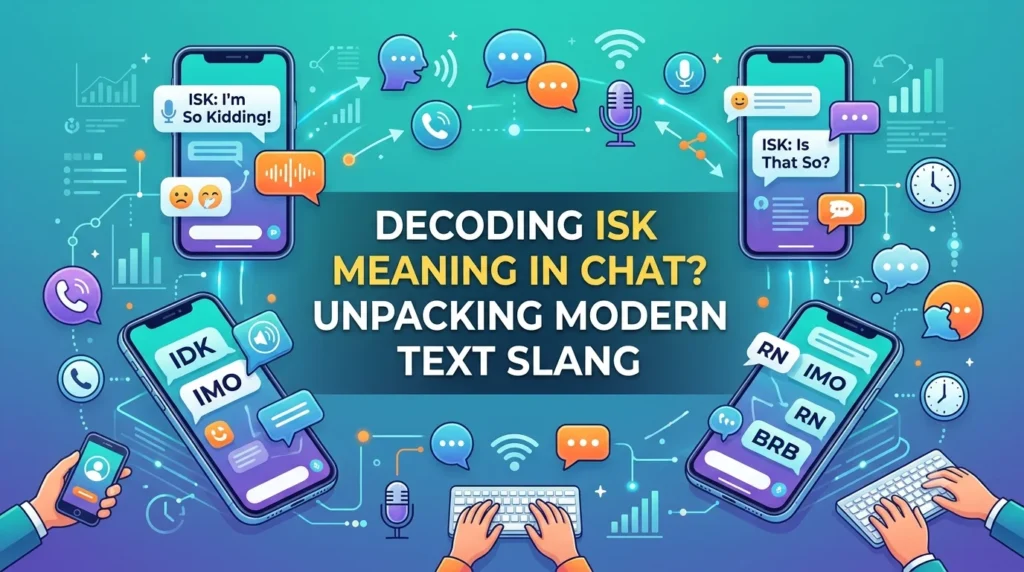
In contemporary text spaces, ISK most commonly functions as a rapid-fire phonetic spelling of “I auxiliary know” or, more accurately, “I s’pose know”—a highly colloquial, slightly defensive variation of “I don’t know” or “I guess I know.” Depending entirely on the platform, it also serves as a heavy marker for “I’m shaking my head” (a structural typo-blend of SMH and IKR), or a direct reference to Icelandic Króna or Eve Online currency in gaming groups.
In standard personal messaging, it acts as a linguistic shield when someone feels put on the spot or mildly uncertain. Rather than typing out a lengthy explanation, this shortcut signals that the speaker is navigating a wave of social hesitation or internal conflict.
Let us look at how it manifests in raw, everyday text formats:
“Are you actually planning on going to the party tonight after everything that happened?”
“isk… i might just stay home.”
“Did you finish the financial summary for tomorrow’s review yet?”
“isk, thought someone else was covering that part.”
“Honestly, do you think they are ever going to fix this broken app update?”
“isk at this point honestly”
The Digital Evolution: Origin and Background
The genesis of this phrase tracks back to early multiplayer gaming lobbies and late-night chat rooms where typing speed dictated survival. Players needed a way to convey sudden doubt or chaotic confusion without sacrificing their physical momentum on a keyboard.
As decentralized web communities expanded, the term naturally migrated toward mainstream social platforms, shedding its hyper-technical roots. It mutated from a simple, lazy keystroke error into an intentional stylistic choice used to signal a specific state of mind.
Today, its cultural footprint is expanding rapidly among digital native groups who prioritize authentic, unfiltered emotional pacing over stiff textbook grammar. It has transformed from a localized piece of slang into a versatile, casual conversational anchor.
Real-Life Conversations: Slang in the Wild
To fully grasp how this unique expression behaves, we have to look directly at how it weaves through different communication streams every single day.
Inside a WhatsApp Group Chat
Person A: We need to finalize the weekend road trip route by tonight or all the good cabins will be booked.
Person B: isk if we can even get everyone to agree on a budget by then tbh.
Sliding Into Instagram DMs
Person A: Did you see their latest story post? It looked like they were throwing serious shade at our group.
Person B: isk, I try not to read too deep into their social media drama anymore.
Scrolling Through TikTok Comments
Person A: Can we all collectively agree that this trend needs to be permanently retired immediately?
Person B: isk it’s kinda lowkey funny though, don’t kill the vibe!
A Casual Text Message Exchange
Person A: Do you think you’ll ever give them a second chance after the way they treated you last semester?
Person B: isk… my mind is a total mess right now.
The Hidden Subtext: Emotional and Psychological Meaning
When a contact drops this acronym into your screen, they are channeling a state of mind that a basic question mark cannot capture. They are projecting vulnerability, letting you know that they feel exposed, overwhelmed, or entirely on the fence about the topic at hand.
Modern text communication relies heavily on these brief verbal buffers to prevent interactions from sounding too aggressive or overly demanding. Using specialized slang builds a comfortable psychological buffer zone, allowing the speaker to retreat into protective ambiguity when necessary.
During my years analyzing interpersonal dynamics in digital learning environments, I watched a student message their project partner saying, “I feel like our whole thesis is completely missing the point.” The partner immediately countered with, “isk, maybe we are just staring at it too long.” That simple three-letter entry instantly lowered the tension, transforming a moment of rising panic into a soft, collaborative breath.
Adapting to the Room: Usage in Different Contexts
The overall impact of this phrasing depends heavily on your history with the recipient and the digital venue hosting your chat.
Social Media Feeds
On public grids, it operates as a tool for public detachment, allowing a user to comment on an issue without taking a hard, definitive stance.
Close Friends and Romantic Relationships
Between intimates, it works as a tender sign of trust, proving that the sender feels safe enough to share their genuine confusion or lack of direction with you.
Professional Settings
In a corporate workspace, utilizing this phrase can severely damage your standing, making you look unreliable, sloppy, or entirely detached to a senior partner.
Shifting from Casual to Serious Tones
While it thrives in casual, late-night text streams, it falls entirely flat during heavy, crisis-driven dialogues where clear clarity is desperately needed.
Knowing the Boundaries: When NOT to Use It
There are critical spaces where falling back on internet abbreviations can deeply wound or alienate the person waiting for your reply.
Using shorthand during a deep emotional apology, a sensitive family emergency, or a high-stakes debate makes you appear unfeeling and completely checked out. If a loved one is opening up about a deep personal struggle, a casual slang reply feels incredibly sterile and dismissive.
Furthermore, when communicating across diverse international lines, relying on hyper-localized internet idioms can trigger instant misunderstandings, grinding a cross-cultural dialogue to a painful stop.
Cleared Confusions: Common Misunderstandings
The single biggest roadblock with this expression is when the recipient reads it through a purely literal lens, mistaking it for a financial update or an Uncommon currency discussion.
Tone misinterpretation happens constantly, as a brief, unpunctuated acronym can easily be misread as passive-aggressive hostility when it was actually meant as a gentle sigh.
[Sender shares a dilemma]
│
├─► Recipient decodes tone ──► “They feel overwhelmed and stuck.”
│
└─► Recipient lacks context ──► “Are they ignoring my question entirely?”
It is vital to recognize that within a standard personal chat, this term is almost always an emotional temperature check rather than a literal data point.
The Slang Spectrum: Quick Comparison Table
| Expression | Core Meaning | Emotional Vibe | Best Use Case |
| ISK | I don’t know / I guess | Hesitant & Guarded | Admitting vulnerability or deep doubt |
| IDK | I Don’t Know | Neutral & Objective | Stating a simple lack of factual data |
| SMH | Shaking My Head | Disappointed & Judgmental | Reacting to someone’s ridiculous choice |
| IKR | I Know, Right? | Enthusiastic & Aligned | Confirming total shared agreement |
| TBH | To Be Honest | Candid & Reflective | Prefacing a slightly risky personal opinion |
Key Insight
While a standard phrase like “IDK” states a clean absence of factual knowledge, “ISK” introduces a heavy layer of emotional hesitation, signaling that the speaker is actively struggling with how their answer might be received.
Digital Flavors: 10 Core Variations You Need to Know
The beauty of contemporary net slang is its fluid ability to twist and morph to convey precise degrees of emotional intensity.
- isk lowkey: Feeling a subtle sense of doubt that you aren’t completely ready to voice out loud.
- big isk: Facing a massive wall of confusion or deep uncertainty that paralyzes your decision-making.
- isk tbh: Blending hesitation with raw honesty to prepare the recipient for a difficult, unvarnished truth.
- isk rn: Expressing that your mind is currently a total blur in this exact, fleeting moment.
- just… isk: A weary sign of mental exhaustion showing that you lack the energy to evaluate the issue.
- isk anymore: Signaling a slow, painful detachment from a long-running, problematic situation.
- heavy isk: Carrying a profound emotional burden of doubt that impacts your closest relationships.
- isk format: Using all caps (ISK) to express a louder, more frantic sense of chaotic mental panic.
- soft isk: A mild, gentle hesitation that can easily be swayed with a bit of encouragement.
- isk structural: Merging the phrase into a longer sentence to soften the blow of an impending rejection.
Mastering the Turn: How to Respond When Someone Uses It
Keeping an online conversation moving along fluidly requires a delicate touch once this acronym lands on your screen.
Casual Responses
- “No worries at all, take all the time you need to figure it out!”
- “Honestly, I am right there in the same boat with you.”
Funny Comebacks
- “Looks like your brain cells went on a temporary strike today too!”
- “I’ll give you three guesses, but the first two don’t count.”
Mature Acknowledgments
- “It is completely okay to not have all the answers figured out right now.”
- “Thank you for being real with me about how stuck you feel.”
Respectful Closures
- “Let’s just drop it for now and revisit it when things clear up.”
- “I am backing your play regardless of what you decide down the line.”
Global Perspectives: Regional and Cultural Usage
Text patterns travel around our world at breakneck speeds, yet their exact psychological definitions change based on where they land.
Western Digital Spaces
Across the US and Europe, it acts as a staple of fast-paced, urban text ecosystems, heavily linked with youth-centric social dynamics.
Asian Messaging Ecosystems
In digital cultures anchored around platforms like WeChat or Line, abstract acronyms are frequently bypassed in favor of deeply expressive character stickers.
Middle Eastern Chats
Young, multilingual texters routinely blend western chat shortcuts with traditional phrases, forming a vibrant linguistic tapestry.
Generational Divides: Gen Z vs. Millennials
While Millennials lean toward grammatically clean, punctuated sentences, Gen Z handles shortcuts as an organic, living art form.
Digital Safety Check: Is It Safe for Kids?
From an educational and parental standpoint, this particular text acronym is completely harmless, containing no hidden toxic references or explicit adult meanings.
It is a functional piece of emotional punctuation that kids use to navigate peer expectations, meaning guardians can rest easy seeing it in messages.
Frequently Asked Questions
Does ISK mean something different in gaming communities?
Yes, in massive multiplayer games like Eve Online, it stands for Interstellar Kredit, which is the primary in-game economy token.
Can this phrase stand for a literal financial term?
Outside of social chats, it is the official currency code for the Icelandic Króna in global banking circles.
Why do people use ISK instead of just typing IDK?
It injects a softer, more colloquial tone of hesitation, making the response sound less cold and mechanical than standard terms.
Is it appropriate to use this acronym in an email to a teacher?
It is highly recommended to avoid it, as academic environments require formal language to maintain proper respect.
How can I tell if someone is angry when they text ISK?
Look closely at the surrounding context; if it is paired with short, single-word answers, it may indicate frustration.
Conclusion: Embracing the Future of Human Connection
Our shared digital language will continue to morph, introducing fresh phrases that push the boundaries of how we express feeling through a screen.
At the end of the day, these tiny textual codes are just modern bridges helping us find real common ground in a fast, hyper-connected world. Go ahead and use them with care to bring a touch of genuine human color to your everyday text circles.