
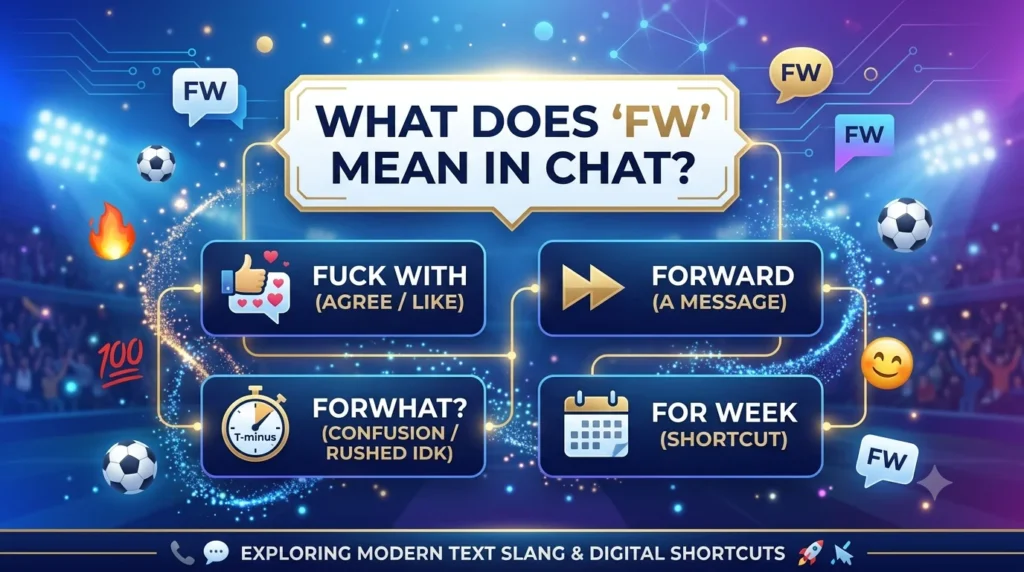
Have you ever opened a direct message or scrolled through a comment thread only to find a simple, two-letter acronym paired with an emoji? Our modern vocabulary moves at a lightning-fast pace, condensing profound human emotions, tastes, and social alignments into brief keystrokes.
Among these hyper-minimalist terms, searching for the exact meaning of fw in chat spaces has become a widespread point of curiosity. The true trickiness of these letters lies in how easily they can switch identities depending on who is sending the message.
One minute it represents a practical email function from the early days of the internet, and the next, it is serving as a powerful cultural stamp of approval among Gen Z circles. Misinterpreting this tiny piece of slang can throw off the entire emotional flow of a casual conversation.
Understanding how these micro-expressions work allows us to communicate with complete social fluency and emotional confidence. Let us peel back the layers of this trendy shorthand to find out how it influences our text-based relationships.
Meaning of FW in Chat – Quick Meaning
In contemporary text messages and social media discussions, FW most frequently stands for “Fck With” (used in a positive sense meaning to like, respect, or highly approve of someone or something).
Its exact interpretation relies heavily on the context of the sentence and the closeness of the people talking.
- Primary Meaning (Approval): Fck With (To heavily support, enjoy, or rock with a vibe, style, song, or person)
- Secondary Meaning (Action): Forward (Passing an existing message, image, or link to another chat)
- Tertiary Meaning (Warning): From Within / For Whoever (Niche conversational brackets used on public forums)
“I really fw that new track you sent over last night, the baseline is incredible.”
“Can you fw that apartment link to the main family group chat?”
“Honestly, I don’t fw people who treat retail workers poorly.”
Origin, Background, and Cultural Journey
From Corporate Forwarding to Urban Dialect
Long before social media apps reshaped the global dialect, the letters “FW:” dominated our corporate email inboxes. It was a functional, cold stamp indicating a forwarded message. However, as internet youth culture merged with hip-hop dialect in the late 2000s and early 2010s, the phrase “I fck with that” entered casual spoken English to denote deep cultural respect.
The Social Media Explosion
When short-form video platforms like TikTok and image-heavy spaces like Instagram took over daily communication, spoken slang naturally transformed into text shorthand. “Fck with” smoothly contracted into FW.
This evolution turned an intense verbal phrase into a highly versatile, low-stakes digital badge. It allowed users to express immense aesthetic alignment, musical tastes, and interpersonal loyalty without having to type out long, overly formal sentences.
Real-Life Conversations Across Modern Platforms
WhatsApp Group Chat
Jordan: Sends a picture of a vintage leather jacket from a local thrift store
Leo: Oh wow, that is an absolute steal for thirty bucks.
Marcus: I heavily fw the collar style on that. You need to buy it immediately before someone else snaps it up.
Instagram Direct Messages
Tanya: Did you catch that indie band’s live set over the weekend?
Elena: Yes! Their entire energy was so electric.
Tanya: Real, I fw their creative direction so much right now. I already bought tickets for their autumn tour.
TikTok Comments Section
User1: The editing style on this video layout is completely unmatched.
User2: I’m saying! The color grading is so warm.
User3: Heavy on this, I fw this creator’s vision all day.
Standard Text Messages
Uncle Robert: Hi kiddo, your mom mentioned you found an internship link for me?
Kevin: Hey Uncle Rob! Yeah, I do have it.
Kevin: Let me fw the official job description email to you tonight so you can look over the requirements.
The Emotional and Psychological Weight Behind the Slang
A Badge of Absolute Authenticity
Texting can occasionally feel clinical, but using a term like “fw” signals a deep, visceral emotional reaction. When a person states that they “fw” your new outfit or your favorite song, they aren’t just saying it’s fine. They are telling you that your taste aligns with their personal identity, offering a hit of genuine validation that deepens social bonds.
The Ease of Casual Vulnerability
Expressing deep admiration in full, formal sentences can sometimes feel heavy or socially intimidating to younger generations. Shortening the emotion into a two-letter phrase acts as a safety valve. It allows a sender to say, I really respect what you are doing, while keeping the overall conversational temperature light, relaxed, and cool.
A Lesson from a Communication Expert
A few years ago, during an urban linguistics study I was conducting, a high school teacher told me about a major misunderstanding she had experienced. A student had written “I fw your teaching style” on an anonymous feedback card.
The teacher initially thought the student was using profanity to mock her methods. Once I explained that it was actually an expression of profound teenage respect, her entire perspective shifted. This shows exactly why modern context matters so much.
Usage in Different Contexts and Settings
Social Media Platforms
On public comment sections, the term functions as a collaborative currency. Users drop it to show instant agreement with an opinion, a fashion trend, or a musical artist, effortlessly grouping themselves into shared online subcultures.
Friends and Casual Relationships
Among close peers, the term is a staple of everyday bonding. It is used to affirm plans, praise personal achievements, or vent about things the group dislikes. It signals an effortless, comfortable dynamic where formal speech barriers are completely lowered.
Work and Professional Environments
Warning: Keep this acronym entirely out of professional chat tools like Slack, Teams, or corporate emails unless you explicitly mean “forward.”
Using the slang definition of this acronym with a manager or client can severely damage your professional standing. It will likely be viewed as highly inappropriate, crude, or dangerously informal for a professional environment.
Professional Alternative: “Hi Sarah, I really appreciate your creative approach to the new marketing layout; it aligns perfectly with our brand’s goals.”
Deciphering Casual vs. Serious Tones
The structural tone changes based on capitalization and surrounding emojis. A lowercase fw next to a spark emoji indicates a fun, trendy appreciation for an aesthetic. A sharp, standalone, capitalized “FW” inside a tense discussion usually shifts back to its structural meaning: an urgent instruction to forward a document.
When to Safely Avoid Using the Acronym
Formal and Cross-Generational Chats
If you are messaging an older relative, a mentor, or someone from a highly traditional background, skip the slang version entirely. The presence of the underlying implicit word can easily cause unnecessary offense, or the recipient will simply end up confused by the abbreviation.
Serious or Solemn Occasions
During moments of grief, professional evaluations, or sensitive life updates, utilizing hyper-shortened slang can feel incredibly dismissive. In these moments, take the extra time to type out full sentences to convey genuine empathy and respect.
Common Misunderstandings and Tone Shifts
The absolute biggest hurdle with this shortcut is its dual life as a professional instruction and an informal endorsement. If your classmate texts you, “Can you fw that study guide?,” and you reply by discussing how much you love the guide’s font choices, you have missed their practical request to pass the file along.
Always look at the placement of nouns within the text thread. If the acronym is followed by a document, link, or email address, read it as forward. If it sits right next to a person’s name, a musical artist, or an item of clothing, it is a statement of personal taste.
Comparing Digital Endorsements
| Digital Slang | Core Intent | Emotional Tone | Best Environment |
| FW | F**ck With / Forward | Visceral, trendy, supportive | Casual direct messages, comments |
| Heavy On It | Deep agreement | Strong, authoritative, clear | Group chats, public forums |
| I’m Feeling It | Moderate liking | Approachable, soft, classic | New friendships, casual chats |
| Valid | Objective approval | Cool, detached, respectful | Peer-to-peer feedback |
| HMU | Hit Me Up | Inviting, open-ended | Making future social plans |
Key Insight
The Muscle of Visceral Approval
While terms like valid offer a cool, detached stamp of logical approval, fw carries an energetic, personal weight that signals true emotional alignment with whatever is being discussed.
Modern Variations and Semantic Offshoots
- Heavily FW: I deeply support this. Expressing an immense level of love for a specific creative work or person.
- Don’t FW: I do not tolerate or like this. A strong statement of personal boundaries or dislike.
- FWU: Fck with you. A direct statement telling the recipient that the sender appreciates and supports them personally.
- Who You FW?: Which side or option do you support? A fast casual question asking for someone’s preference.
- FW The Vision: Supporting someone’s long-term plan. Used frequently to praise young entrepreneurs or artists.
- FW: Re: Forwarded reply. The classic, old-school email header format that still lives in corporate environments.
- Hard to FW: Difficult to like or enjoy. Used when something misses the mark or feels inherently unappealing.
- FWM: Fck with me. A playful or confident invitation for others to connect, collaborate, or hang out with you.
How to Respond Smoothly Based on the Vibe
Casual & Friendly Responses
“Love that you like it! I’ve been obsessed with this style for weeks now.”
“Haha thanks! I knew you’d get the vibe completely.”
Funny & Witty Comebacks
“Careful, my taste is highly contagious.”
“Of course you do, I have impeccable style and you clearly have great eyes.”
Mature & Balanced Replies
“I appreciate the compliment! It took a lot of work to get this project looking right.”
“Thanks for saying that, it means a lot coming from someone with your eye for detail.”
Respectful & Clear Boundaries (For the Negative Variation)
“That’s completely fair, everyone has different preferences when it comes to this stuff.”
“I understand we don’t see eye-to-eye on this, so let’s just focus on our common goals.”
Regional, Cultural, and Generational Adaptations
Western Youth Spaces
In metropolitan areas across North America and the UK, this abbreviation is deeply woven into the fabric of daily text communication. It crosses creative boundaries, popping up constantly in discussions about fashion, underground hip-hop music, and internet pop culture.
Global Internet Spaces
In non-Western territories where English serves as a second language, the slang version is much less common. International users almost exclusively understand the letters through their classic, structural email identity of forwarding a message.
The Generational Divide: Gen Z vs. Millennials
Gen Z drops this phrase into conversations effortlessly, reading the implicit tone shifts without a single moment of hesitation. They view it as a normal, non-offensive way to build rapid social alignment.
Millennials, however, tend to use the term with a high degree of caution. Because the underlying root word is profanity, they often stick to safer alternatives like rock with or type out full phrases to ensure their texts remain clean and universally understood.
Digital Safety: Is This Expression Safe for Kids?
For parents reviewing their children’s digital messaging feeds, this acronym requires a small amount of context awareness. While the term is generally benign and used simply to discuss pop culture, its literal root word is a swear word.
If it appears constantly in your teenager’s text threads, they aren’t necessarily acting out or engaging in dangerous behavior; they are simply using the standard currency of modern peer validation. It serves as a great starting point for a casual, non-judgmental chat about language boundaries.
Frequently Asked Questions
Does FW always imply a bad word in text message threads?
When used as slang, yes, it stands for an implicit curse word. However, its actual usage is completely positive, functioning as a high-energy synonym for “like,” “approve,” or “support.”
How can I tell if someone wants me to forward a link or if they like it?
Look at the sentence structure. If they say “fw this to me,” it’s an action command to forward. If they say “I fw this,” they are expressing their personal admiration for the item.
Is it acceptable to use FW in a university essay or cover letter?
Absolutely not. Academic and professional writing demands formal, standard English. Keep this abbreviation strictly confined to your casual personal messages and informal social media feeds.
What does “Don’t FW me” mean?
This is a sharp personal boundary statement. It means “do not mess with me,” “do not bother me,” or “do not disrupt my peace of mind.”
Why do younger people prefer abbreviations over real words?
It matches the fast, continuous pace of modern digital feeds. Shorthand allows users to express complex, nuanced social feelings instantly without stalling their conversational flow.
The Final Keystroke: Moving Forward with Confidence
Human communication has never been a rigid, unmoving statue; it is a living, breathing ecosystem that continuously alters its shape to match the digital landscapes we live in. Hyper-short cuts are not ruining our ability to express deep human thoughts—they are simply giving us a fresh, modern canvas to map them out.
The next time these two letters pop up in your notifications, you will not have to guess what the sender is thinking. By reading the context, noting your relationship dynamic, and applying the right definition, you can text back with absolute authority and social ease.