If you’ve spent any time texting, scrolling through social media, or chatting online, you’ve probably come across the abbreviation “NTY.” At first glance, it may seem confusing, especially if you’re unfamiliar with modern internet slang. Many people search for “what does it mean” because they’ve received it in a message and aren’t sure whether it’s friendly, rude, polite, or something in between.
The good news is that it is actually one of the simplest and most useful texting abbreviations used today. It’s short, direct, and usually intended to decline something politely without creating unnecessary awkwardness.
As digital communication becomes faster and more informal, abbreviations like it help people express themselves efficiently. Understanding what it means can help you interpret conversations correctly and avoid misunderstandings in both personal and online interactions.
In this guide, you’ll learn its meaning, origins, emotional implications, real-life usage examples, cultural differences, and the best ways to respond when someone sends it.
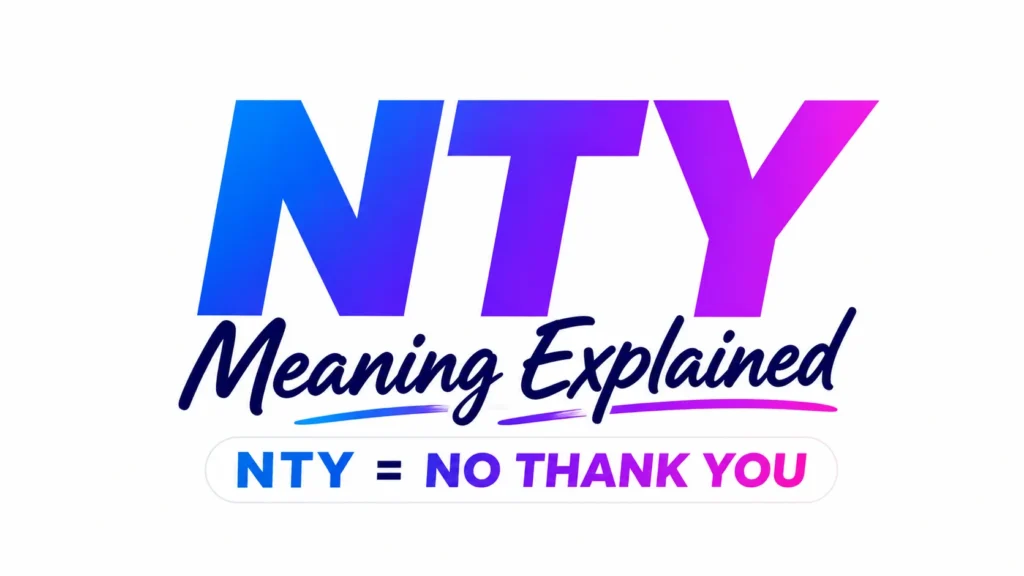
NTY Meaning – Quick Meaning
What Does NTY Mean?
NTY stands for:
No Thank You
It is commonly used in text messages, social media conversations, online gaming chats, and messaging apps when someone wants to politely decline an offer, invitation, suggestion, or request.
Quick Definition
it is a short and friendly way to say:
- No thank you
- I appreciate the offer, but I’ll pass
- I’m not interested
- Thanks, but not for me
The phrase is usually polite rather than offensive.
Simple Examples
“Want to join us tonight?”
“NTY, I’m staying home.”
“Would you like a free trial?”
“NTY.”
“Can I set you up with someone?”
“NTY, but thanks.”
Origin & Background
Where Did NTY Come From?
NTY emerged from the broader culture of internet abbreviations and SMS texting. During the early days of mobile phones, character limits encouraged users to shorten common phrases.
Expressions such as:
- LOL (Laugh Out Loud)
- BRB (Be Right Back)
- TY (Thank You)
- NP (No Problem)
became widely accepted.
Over time, “No Thank You” was naturally shortened to it.
Influence of Online Communication
As messaging apps became more popular, users sought faster ways to respond. Rather than typing a full sentence, NTY allowed people to politely reject offers with just three letters.
The abbreviation became especially common in:
- Online gaming communities
- Social media comments
- Marketplace transactions
- Dating apps
- Group chats
Social Media Impact
Platforms like Instagram, TikTok, Snapchat, and Discord helped spread NTY among younger generations.
Its popularity increased because it balances two important goals:
- Being concise
- Remaining respectful
How the Meaning Evolved
Originally, NTY was simply a shortened version of “No Thank You.”
Today, however, its tone depends heavily on context.
For example:
- Friendly NTY = polite decline
- Dry NTY = brief rejection
- Playful NTY = humorous refusal
The words remain the same, but the emotional meaning can shift based on the conversation.
Real-Life Conversations
WhatsApp Conversation
Person A:
“Hey, want to come shopping with us tomorrow?”
Person B:
“NTY, I already have plans with my family.”
Person A:
“No worries. Have fun!”
Instagram DM
Person A:
“Would you like to collaborate on this project?”
Person B:
“NTY, but I appreciate the offer.”
Person A:
“Thanks for letting me know.”
TikTok Comments
Person A:
“You should totally try this challenge.”
Person B:
“NTY 😂”
Person A:
“Fair enough.”
Text Message
Person A:
“Can I call you right now?”
Person B:
“NTY. I’m trying to finish some work.”
Person A:
“Got it. Talk later.”
These examples show how itoften helps maintain politeness while setting boundaries.
Emotional & Psychological Meaning
What Emotion Does NTY Express?
Most of the time, NTY communicates:
- Respect
- Appreciation
- Personal preference
- Boundaries
Unlike a blunt “No,” NTY softens the rejection.
Why People Use It
People often choose NTY because they want to:
- Avoid sounding rude
- End a conversation quickly
- Protect their time
- Decline without lengthy explanations
What It Reveals About Modern Communication
Modern communication values efficiency.
Many people prefer short responses that clearly communicate their intentions. NTY reflects this trend perfectly.
Instead of writing:
“I appreciate the invitation, but unfortunately I won’t be able to attend.”
someone can simply write:
“NTY.”
The message remains understandable while saving time.
Personal-Style Scenario
Imagine receiving multiple invitations during a busy week.
You appreciate your friends thinking about you, but you’re exhausted and need downtime. Rather than ignoring their messages or writing long explanations repeatedly, NTY allows you to politely decline while preserving the relationship.
That balance between honesty and courtesy is one reason the abbreviation remains popular.
Usage in Different Contexts
Social Media
On social media, NTY is commonly used when:
- Rejecting suggestions
- Declining challenges
- Responding to promotional offers
- Turning down requests
The tone is generally casual.
Friends and Relationships
Among friends, NTY often sounds friendly and harmless.
Example:
“Want pizza tonight?”
“NTY, I’m craving something lighter.”
In relationships, context matters. Adding warmth often helps avoid sounding distant.
Work and Professional Settings
Professional environments usually favor complete sentences.
Instead of NTY, consider:
“Thank you for the opportunity, but I’ll have to decline.”
Using the full phrase appears more polished and respectful.
Casual vs Serious Tone
Casual:
“NTY lol”
Serious:
“NTY, I don’t feel comfortable with that.”
The abbreviation itself stays the same, but accompanying words shape the overall tone.
When NOT to Use It
Formal Business Communication
Avoid NTY in:
- Job interviews
- Business emails
- Client communication
- Professional proposals
A complete response demonstrates professionalism.
Sensitive Situations
When emotions are involved,it may appear dismissive.
Examples include:
- Serious discussions
- Family conflicts
- Emotional support conversations
In these situations, additional explanation is often better.
Cultural Sensitivity
Some cultures value detailed expressions of gratitude and respect.
A brief it may feel overly abrupt even when no offense is intended.
Situations That May Cause Confusion
Not everyone knows internet slang.
Older relatives, coworkers, or international contacts may misunderstand the abbreviation.
Using the full phrase can prevent confusion.
Common Misunderstandings
People Think It Means Something Negative
One common misconception is that it is rude.
In reality, it is usually a polite refusal.
Tone Can Be Misread
Text lacks facial expressions and vocal cues.
As a result, a simple it can sometimes feel colder than intended.
Literal vs Figurative Meaning
Literally, it means “No Thank You.”
Figuratively, it may communicate:
- Lack of interest
- Personal preference
- A desire for space
- A humorous rejection
The surrounding conversation determines the exact meaning.
Comparison Table
| Expression | Meaning | Tone | Usage |
| NTY | No Thank You | Polite | Declining offers |
| NTYVM | No Thank You Very Much | More emphatic | Strong refusal |
| Nah | No | Casual | Friends |
| Nope | Negative response | Informal | Everyday chat |
| Pass | Not interested | Relaxed | Social situations |
| Maybe Later | Not now | Neutral | Delayed decision |
| Sure | Yes | Positive | Acceptance |
| Absolutely | Strong yes | Enthusiastic | Agreement |
Key Insight
it occupies a unique middle ground. It is more polite than “Nope,” more concise than a full sentence, and generally less harsh than a direct rejection. That balance makes it one of the most practical abbreviations in digital communication.
Variations / Types
NTY
Standard form meaning “No Thank You.”
NTYVM
No Thank You Very Much.
Adds stronger emphasis.
No Ty
A casual variation with similar meaning.
Nty 🙂
Adds friendliness through an emoji.
Nty lol
Softens the refusal with humor.
NTY Bro
Friendly rejection among friends.
NTY Thanks
Reinforces appreciation.
Hard NTY
Strong disagreement or refusal.
Big NTY
Emphasizes complete lack of interest.
NTY Maybe Another Time
Declines now while leaving future possibilities open.
How to Respond When Someone Uses It
Casual Replies
- “No worries.”
- “Maybe next time.”
- “All good.”
Funny Replies
- “Worth a try 😂”
- “Had to ask.”
- “Mission failed.”
Mature Replies
- “Thanks for letting me know.”
- “I appreciate the honest response.”
- “Completely understandable.”
Respectful Replies
- “Thank you for responding.”
- “I respect your decision.”
- “Have a great day.”
Responding respectfully helps keep conversations positive.
Regional & Cultural Usage
Western Culture
In North America and much of Europe, NTY is generally viewed as polite and efficient.
Most younger internet users immediately understand it.
Asian Culture
In many Asian societies, indirect communication is often preferred.
While NTY is understood online, people may choose longer responses to demonstrate courtesy.
Middle Eastern Culture
Hospitality and politeness are highly valued.
Because of this, some users may add additional words after NTY to sound warmer and more appreciative.
Global Internet Usage
Online communities worldwide recognize NTY.
Gaming platforms, social media sites, and messaging apps have helped create a shared understanding of the abbreviation.
Gen Z vs Millennials
Gen Z
- Uses NTY frequently
- Comfortable with abbreviations
- Values quick communication
Millennials
- Understand NTY well
- May use full phrases more often
- Often adjust style based on audience
Is It Safe for Kids?
Understanding the Context
Yes, NTY is generally safe for kids.
It is not offensive, explicit, or inappropriate.
In fact, it can teach an important communication skill: politely saying no.
Parents and educators can view NTY as a harmless abbreviation that encourages respectful boundary-setting when used appropriately.
FAQs
What does NTY mean in text messages?
it means “No Thank You.” It is a polite way to decline an offer, invitation, or suggestion.
Is NTY rude?
Usually no. NTY is generally considered respectful and courteous, though tone and context matter.
What does NTY mean on Snapchat?
On Snapchat, it carries the same meaning: “No Thank You.” Users often send it as a quick response to offers or requests.
What does NTY mean on TikTok?
TikTok users commonly use NTY in comments to politely reject challenges, trends, products, or suggestions.
Can NTY be used professionally?
It’s better to avoid NTY in formal business communication. Writing out “No, thank you” sounds more professional.
What is the difference between NTY and Nope?
it sounds more polite because it includes gratitude. Nope is usually more direct and informal.
Does NTY always mean rejection?
Yes, it generally indicates refusal, but the tone can range from friendly and humorous to firm and serious.
Conclusion
Understanding what NTY means can make online conversations much easier to interpret. At its core, the abbreviation simply means “No Thank You,” offering a quick and polite way to decline something without sounding unnecessarily harsh.
Whether you encounter it in a text message, Instagram DM, TikTok comment, or group chat, NTY usually reflects respect, personal preference, and healthy boundaries. Context always matters, but in most situations, the abbreviation carries a friendly and courteous tone.
As digital communication continues to evolve, expressions like NTY help people communicate clearly while keeping conversations efficient. Once you recognize its meaning, you’ll be able to use it confidently and understand exactly what others are trying to say.