
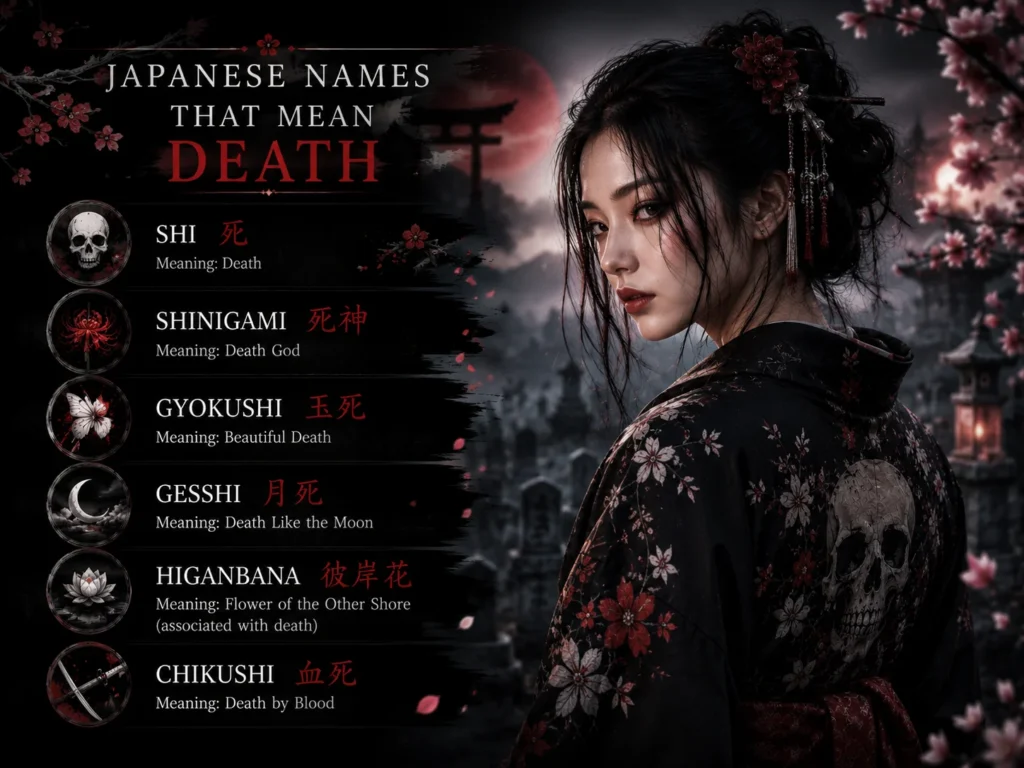
This guide presents 160 Japanese death-related ideas across eight categories, including literal vocabulary, afterlife terms, folklore figures, dark personal names, and symbols of impermanence. Because conventional Japanese given names almost never mean “death” literally, every entry is labeled by context to avoid presenting ordinary words or supernatural titles as real baby names.
Do Japanese Names Literally Mean Death?
The direct Japanese word for death is shi (死). Although 死 is a standard kanji, it is not conventionally used in personal names because of its strongly negative meaning. Kanjipedia
Most usable Japanese names associated with mortality express the theme indirectly through:
- Night and fading light
- Autumn leaves and winter snow
- Mist, dew, and brief moments
- Memory and prayer
- Flowers and seasonal renewal
- Spirits and mythology
- The Buddhist concept of impermanence
Names such as Sayo, Setsuna, Shigure, and Mafuyu have authentic dark or transient imagery. Words such as Yomi, Meikai, and Shinigami are suitable for fictional identities but are not conventional human names.
How to Choose an Accurate Japanese Death Name
Decide How the Name Will Be Used
A baby, realistic character, supernatural figure, gaming username, and fictional clan require different standards. Use established personal names for real people and reserve direct death vocabulary for fantasy or horror projects.
Always Include the Kanji
Japanese names with identical pronunciations can carry different meanings. Rei written 礼 means respect, while 霊 means spirit. The spoken form alone does not reveal the intended meaning.
Use Established Naming Patterns
The Season + 子 (ko, “child”) formula appears in traditional feminine names:
- Akiko — 秋子, “autumn child”
- Fuyuko — 冬子, “winter child”
- Yukiko — 雪子, “snow child”
The Nature Symbol + 美 (mi, “beauty”) pattern creates poetic names:
- Akimi — 秋美, “autumn beauty”
- Fuyumi — 冬美, “winter beauty”
- Yukimi — 雪美, “snow beauty”
For atmospheric character names, use a verified standalone concept:
- Setsuna — 刹那, “a brief moment”
- Kasumi — 霞, “mist”
- Hotaru — 蛍, “firefly”
Do Not Invent Readings
Combining two attractive kanji does not automatically create a valid Japanese name. Check that the pronunciation is genuinely associated with the written characters.
Japan permits designated common-use and name-use characters for registered names. Current registration rules also require a generally recognizable relationship between the kanji and recorded pronunciation. Japan’s Ministry of Justice, official furigana guidance
Literal Japanese Words for Death
These are real Japanese vocabulary terms, not normal personal names. They work best for dark fiction, supernatural titles, usernames, and world-building.
- Shi (死) — Death
- Shibō (死亡) — Death or decease
- Shisha (死者) — Deceased person
- Shikyo (死去) — Passing away
- Eimin (永眠) — Eternal sleep
- Saigo (最期) — Final moment of life
- Shūen (終焉) — Final end or demise
- Botsu (没) — Death or passing
- Zetsumei (絶命) — Expiration of life
- Kyūshi (急死) — Sudden death
- Rinshi (臨死) — Near death
- Shikabane (屍) — Corpse
- Igai (遺骸) — Mortal remains
- Nakigara (亡骸) — Remains of the deceased
- Mōja (亡者) — Spirit of a dead person
- Bōrei (亡霊) — Ghost of the deceased
- Yūrei (幽霊) — Ghost
- Reikon (霊魂) — Soul or spirit
- Tamashii (魂) — Soul
- Shibetsu (死別) — Bereavement through death
These terms differ in tone. Shibō is direct and factual, eimin is euphemistic, and yūrei specifically refers to a ghost.
Japanese Names and Words for the Afterlife
These established religious, mythological, and literary terms describe worlds beyond life, spiritual transition, or impermanence. They are concepts rather than ordinary given names.
- Yomi (黄泉) — Underworld in Japanese mythology
- Meikai (冥界) — World of the dead
- Meido (冥土) — Realm of the deceased
- Ano Yo (あの世) — The other world
- Higan (彼岸) — The other shore
- Jōdo (浄土) — Pure Land
- Rinne (輪廻) — Cycle of rebirth
- Tensei (転生) — Reincarnation
- Mujō (無常) — Impermanence
- Nehan (涅槃) — Nirvana
- Jōbutsu (成仏) — Attaining spiritual peace
- Meifuku (冥福) — Peace in the afterlife
- Gokuraku (極楽) — Paradise or Pure Land
- Jigoku (地獄) — Hell
- Reikai (霊界) — Spirit world
- Kakuriyo (幽世) — Hidden or spiritual world
- Tokoyo (常世) — Eternal world
- Utsushiyo (現世) — The present mortal world
- Sanzu (三途) — The three paths after death
- Shide (死出) — Departure from life
The kanji 冥 can mean darkness or the world of the dead, while 幽 can refer to something hidden, faint, or otherworldly. These meanings do not make every word containing those characters a personal name. Kanjipedia on 冥, Kanjipedia on 幽
Death-Associated Japanese Mythology and Folklore Names
These are established deities, legendary characters, ghosts, or supernatural titles. Use them for mythological references and fictional characters rather than realistic modern people.
- Izanami (伊邪那美) — Creator goddess associated with Yomi
- Enma (閻魔) — Judge of the dead
- Shinigami (死神) — Death deity or death spirit
- Datsueba (奪衣婆) — Old woman beside the Sanzu River
- Keneo (懸衣翁) — Old man associated with judgment after death
- Jizō (地蔵) — Bodhisattva associated with protection and the dead
- Yuki-onna (雪女) — Snow woman
- Hone-onna (骨女) — Bone woman
- Ubume (産女) — Maternal spirit in folklore
- Oiwa (お岩) — Ghost from Yotsuya Kaidan
- Okiku (お菊) — Ghost associated with the plate-counting legend
- Otsuyu (お露) — Ghostly heroine of Botan Dōrō
- Hashihime (橋姫) — Supernatural “bridge princess”
- Kasha (火車) — Supernatural creature associated with corpses
- Gashadokuro (がしゃどくろ) — Giant skeletal spirit
- Onryō (怨霊) — Vengeful spirit
- Kurozuka (黒塚) — Witch or demoness of a famous legend
- Yamauba (山姥) — Mountain witch
- Kuchisake-onna (口裂け女) — Slit-mouthed woman
- Teke Teke (テケテケ) — Modern supernatural legend
Only a few entries, such as Izanami, Oiwa, Okiku, and Otsuyu, resemble personal names. Others are titles, categories of spirits, or creature names.
Japanese Personal Names Connected to Night
These are genuine, rare, literary, or plausible personal names with night, evening, moon, and starlight imagery.
- Sayo (小夜) — Little night
- Maya (真夜) — True night
- Saya (沙夜) — Sand and night
- Yūna (夕奈) — Evening with the phonetic ending na
- Yūka (夕花) — Evening flower
- Yūmi (夕美) — Evening beauty
- Yūko (夕子) — Evening child
- Yūri (夕莉) — Evening jasmine
- Yūhi (夕日) — Evening sun
- Yuzuki (夕月) — Evening moon
- Yoiko (宵子) — Evening child
- Yoruko (夜子) — Night child
- Kaguya (輝夜) — Radiant night
- Seiya (星夜) — Starry night; generally unisex
- Hoshiko (星子) — Star child
- Tsukiko (月子) — Moon child
- Tsukimi (月美) — Moon beauty
- Mizuki (美月) — Beautiful moon
- Mitsuki (光月) — Light and moon
- Hotaru (蛍) — Firefly
Sayo, Mizuki, Yuzuki, and Hotaru are especially useful for realistic characters because they express darkness indirectly without sounding like horror labels.
Japanese Names Connected to Autumn and Winter
Seasonal endings provide a culturally natural way to suggest mortality, silence, and change without using the word death.
- Aki (秋) — Autumn
- Akiko (秋子) — Autumn child
- Akimi (秋美) — Autumn beauty
- Akina (秋菜) — Autumn greens
- Akino (秋乃) — Autumn with the ending no
- Chiaki (千秋) — A thousand autumns
- Momiji (紅葉) — Crimson autumn leaves
- Kaede (楓) — Maple
- Shigure (時雨) — Late-autumn shower
- Fuyu (冬) — Winter
- Fuyuko (冬子) — Winter child
- Fuyumi (冬美) — Winter beauty
- Fuyuka (冬花) — Winter flower
- Fuyuna (冬奈) — Winter with the ending na
- Mafuyu (真冬) — Midwinter
- Yuki (雪) — Snow
- Yukiko (雪子) — Snow child
- Koyuki (小雪) — Little snow
- Miyuki (美雪) — Beautiful snow
- Yukina (雪菜) — Snow and greens
Shigure creates a somber, literary mood, while Mafuyu feels colder and more dramatic. Kaede and Momiji suggest beautiful change rather than death itself.
Japanese Names About Transience and Memory
These personal names express brief existence, fading natural beauty, distance, prayer, remembrance, or cycles.
- Setsuna (刹那) — A brief instant
- Kasumi (霞) — Mist or haze
- Shizuku (雫) — Droplet
- Tsuyu (露) — Dew
- Nagi (凪) — Calm wind
- Nagisa (渚) — Shore
- Mio (澪) — Waterway
- Sazanami (漣) — Ripple
- Mayu (繭) — Cocoon
- Ibuki (息吹) — Breath or sign of life
- Koharu (小春) — Little spring
- Haruka (遥) — Distant
- Kanata (彼方) — Beyond or far side
- Inori (祈) — Prayer
- Shinobu (偲) — To remember someone
- Omoi (想) — Thought or remembrance
- Chiyo (千代) — A thousand generations
- Towa (永遠) — Eternity
- Tamaki (環) — Circle or cycle
- Meguru (巡) — To revolve or return
For a character connected to grief or remembrance, Shinobu and Inori are more authentic than assigning the literal word shi as a personal name.
Japanese Names Representing Renewal After Death
Not every death-related identity needs a gloomy meaning. These real names represent flowers, light, love, hope, and continuing life.
- Sakura (桜) — Cherry blossom
- Ren (蓮) — Lotus
- Renge (蓮華) — Lotus blossom
- Suiren (睡蓮) — Water lily
- Hana (花) — Flower
- Tsubaki (椿) — Camellia
- Kiku (菊) — Chrysanthemum
- Shion (紫苑) — Aster
- Sumire (菫) — Violet
- Yuri (百合) — Lily
- Ume (梅) — Plum blossom
- Akari (灯) — Lamp or light
- Hikari (光) — Light
- Nozomi (望) — Hope or wish
- Megumi (恵) — Blessing
- Kokoro (心) — Heart or spirit
- Kizuna (絆) — Bond
- Mikoto (命) — Life
- Sachi (幸) — Happiness
- Madoka (円) — Circle or completeness
These choices suit memorial characters, rebirth narratives, and stories in which loss leads to hope. Their direct meanings remain positive.
Dark Japanese Words for Characters and Usernames
These authentic words create a shadowy aesthetic but are not necessarily personal names.
- Yami (闇) — Darkness
- Kage (影) — Shadow
- Kurai (暗い) — Dark or gloomy
- Ankoku (暗黒) — Deep darkness
- Kuro (黒) — Black
- Kokutan (黒檀) — Ebony
- Sumi (墨) — Black ink
- Kon (紺) — Navy blue
- Murasaki (紫) — Purple
- Ai (藍) — Indigo
- Ruri (瑠璃) — Lapis lazuli
- Oboro (朧) — Hazy or indistinct
- Kiri (霧) — Fog
- Shin’en (深淵) — Abyss
- Kyomu (虚無) — Emptiness or nothingness
- Maboroshi (幻) — Illusion or phantom
- Utsuro (虚ろ) — Hollow or vacant
- Shijima (静寂) — Deep silence
- Yūgen (幽玄) — Subtle, mysterious profundity
- Tasogare (黄昏) — Twilight
Yami, Kage, and Kuro work naturally as usernames or character codenames, but they would sound more like concepts than ordinary Japanese personal names.
Common Mistakes With Japanese Death Names
Avoid translating names from sound alone. A syllable pronounced shi does not necessarily use 死 or carry any connection to death.
Frequent errors include:
- Claiming Shino means death
- Translating Rei automatically as ghost
- Presenting Yami as a common given name
- Calling Yūrei a baby name
- Treating Shinigami as a personal surname
- Combining random kanji with invented readings
- Ignoring whether a name is masculine, feminine, or unisex
- Confusing folklore creatures with historical people
- Giving every flower a universal funeral meaning
For a realistic person, use an established name such as Sayo, Hotaru, Shigure, Setsuna, or Shinobu. Use Yomi, Meikai, Onryō, and Shinigami only when a supernatural or symbolic identity is intended.
Frequently Asked Questions
What Japanese name literally means death?
Shi (死) is the direct Japanese word for death, but it is not a conventional personal name. Japanese people generally use indirect seasonal, spiritual, or poetic symbolism in names.
What Japanese name means the underworld?
Yomi (黄泉) is the underworld of Japanese mythology. Meikai (冥界) also means the world of the dead, but both are vocabulary terms rather than ordinary names.
What is a Japanese girl’s name associated with death?
Shinobu (偲) can carry the idea of remembering someone, while Setsuna (刹那) means a brief moment. Shigure, Sayo, and Mafuyu offer darker seasonal or nighttime imagery.
What Japanese boy’s name has a dark meaning?
Dark masculine or unisex possibilities include Kanata, “beyond,” Seiya, “starry night,” and Subaru, referring to the Pleiades. Always confirm the intended kanji because the meaning changes with its spelling.
Does Rei mean death in Japanese?
No. Rei has multiple possible kanji and meanings. 礼 means respect or courtesy, while 霊 means spirit; neither directly means death.
Can I use Shinigami as a Japanese name?
Shinigami means a death deity or death spirit. It is appropriate as a supernatural title, username, or fictional role but not as a realistic human name.
What Japanese name symbolizes impermanence?
Setsuna means a brief instant, Tsuyu means dew, and Kasumi means mist. Each suggests something beautiful that does not remain forever.
Conclusion
These 160 Japanese names for death range from direct vocabulary and supernatural titles to genuine personal names expressing night, winter, remembrance, and renewal. For a realistic name, consider Sayo, Hotaru, Shigure, Setsuna, Shinobu, Inori, or Mafuyu.
Always include the intended kanji, verify its established reading, and distinguish personal names from ordinary words. Before using an unusual name for a real child, confirm its cultural suitability and legal availability with a fluent Japanese speaker and the relevant registration authority.