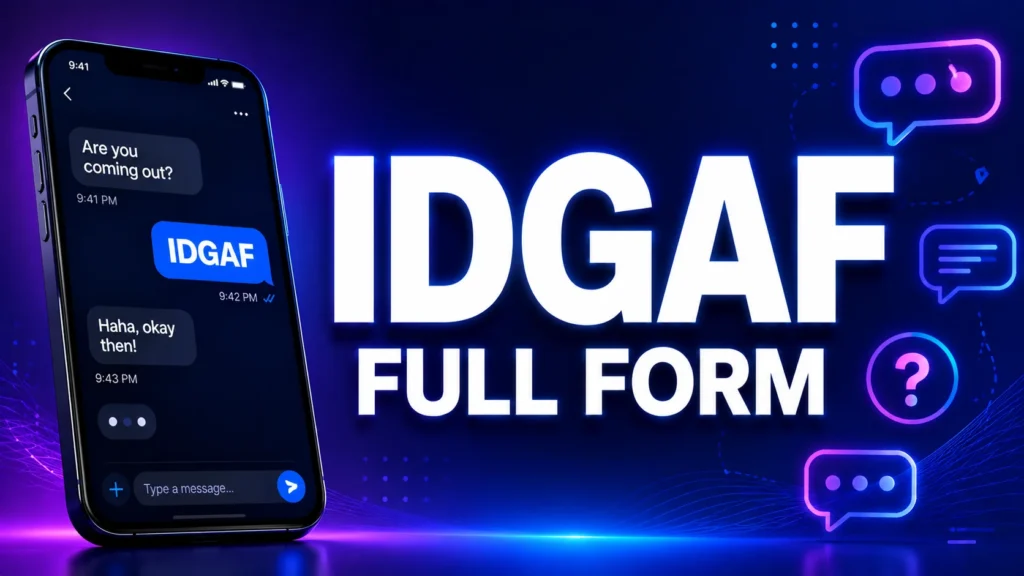
If you’ve been scrolling through TikTok, Instagram, Snapchat, or chatting with friends, you’ve probably come across the abbreviation IDGAF. It often appears in captions, memes, text messages, and online arguments, leaving many people wondering what it actually means.
Understanding internet slang can help you avoid confusion and communicate more naturally online. In this guide, you’ll learn the IDGAF full form in chat, where it came from, how people use it today, and whether it’s appropriate in different situations.
IDGAF Full Form in Chat – Quick Meaning
What Does IDGAF Mean?
IDGAF stands for:
I Don’t Give A F*.**
It is a strong slang expression used to show complete indifference, lack of concern, or emotional detachment about a person, situation, or opinion.
Although the abbreviation hides the explicit word, most people recognize its original meaning.
Simple Definition
IDGAF means:
- I don’t care.
- It doesn’t bother me.
- Your opinion doesn’t affect me.
- I’m not emotionally invested.
Quick Examples
“People keep judging me, but IDGAF.”
“Wear whatever makes you happy. IDGAF what others think.”
“They ignored my message, and honestly, IDGAF anymore.”
Origin and Background
Where Did IDGAF Come From?
The phrase “I don’t give a f***” has existed in spoken English for decades. As texting became popular in the early 2000s, people shortened lengthy phrases into acronyms to save time.
That’s when IDGAF became common in:
- SMS texting
- Internet forums
- Online gaming
- Social media platforms
Social Media Influence
Today, IDGAF is widely used on:
- TikTok captions
- Instagram Reels
- Snapchat stories
- X (Twitter)
- Facebook posts
- Discord chats
Many influencers use it to project confidence, independence, or emotional strength.
How Its Meaning Has Evolved
Originally, IDGAF sounded extremely aggressive.
Today, depending on the context, it can express:
- Confidence
- Self-respect
- Emotional burnout
- Frustration
- Humor
- Sarcasm
Real-Life Conversations
WhatsApp Chat
Person A: Everyone keeps talking about your new haircut.
Person B: IDGAF. I like it.
Instagram DM
Person A: Someone left another negative comment.
Person B: Let them. IDGAF anymore.
TikTok Comments
Person A: People are going to hate this outfit.
Person B: IDGAF. Wear what makes you happy.
Text Message
Person A: Are you worried about what everyone thinks?
Person B: Honestly… IDGAF now.
Emotional and Psychological Meaning
What Emotion Does It Express?
IDGAF often reflects:
- Confidence
- Emotional exhaustion
- Independence
- Defiance
- Acceptance
Sometimes it signals healthy confidence.
Other times, it may hide disappointment or emotional pain.
Why Do People Use It?
People use IDGAF because they want to show they are no longer controlled by:
- Criticism
- Gossip
- Social pressure
- Negative opinions
What It Reveals About Modern Communication
Online culture encourages short, emotionally powerful expressions.
Instead of writing:
“I’ve decided not to let people’s opinions affect me.”
Many simply write:
“IDGAF.”
Personal Scenario
Imagine spending weeks working on a project. After receiving unfair criticism online, you finally decide to stop worrying about strangers’ opinions. Posting “IDGAF” can express that emotional turning point in just five letters.
Usage in Different Contexts
Social Media
Common in:
- Captions
- Comments
- Memes
- Stories
Example:
“Living my life. IDGAF.”
Friends and Relationships
Friends often use it jokingly.
Example:
“IDGAF where we eat.”
However, saying it during an argument may sound rude.
Work or Professional Settings
Avoid using IDGAF at work.
It appears disrespectful and unprofessional.
Instead, say:
- “I’m not concerned.”
- “It isn’t a priority.”
- “I’m okay with either option.”
Casual vs. Serious Tone
Casually, it may sound funny.
In serious conversations, it can feel dismissive or offensive.
When NOT to Use It
Avoid using IDGAF:
- During professional meetings
- In job interviews
- While emailing clients
- When speaking with teachers
- Around people who dislike profanity
- During sensitive family discussions
Using it carelessly may damage relationships or create misunderstandings.
Common Misunderstandings
People Think It Always Means Confidence
Not always.
Sometimes it hides sadness, disappointment, or emotional burnout.
Tone Can Be Confusing
Depending on context, IDGAF can sound:
- Funny
- Angry
- Empowering
- Rude
- Sarcastic
Literal vs. Figurative Meaning
Most people don’t literally mean they care about nothing.
Usually, they only mean they no longer care about one specific situation.
Comparison Table
| Expression | Meaning | Tone |
|---|---|---|
| IDGAF | I don’t care at all | Strong |
| IDC | I don’t care | Mild |
| Whatever | Indifference | Casual |
| No worries | Relaxed acceptance | Friendly |
| I couldn’t care less | Complete indifference | Direct |
| I care | Opposite of IDGAF | Supportive |
Key Insight
IDGAF is much stronger than IDC. While both express indifference, IDGAF carries more emotion and often includes frustration or defiance.
Variations and Similar Expressions
IDC
“I don’t care.”
A softer version.
DGAF
“Don’t give a f***.”
Often used in memes.
Zero F’s Given
A humorous way to express total indifference.
Couldn’t Care Less
A common English expression with similar meaning.
Whatever
Shows mild indifference.
Meh
Expresses boredom or lack of interest.
Not Bothered
A polite alternative.
No Big Deal
Suggests something isn’t important.
It Doesn’t Matter
Neutral and respectful.
I’m Fine Either Way
Professional alternative when discussing choices.
How to Respond When Someone Uses IDGAF
Casual Replies
- “Fair enough.”
- “You do you.”
- “That’s your choice.”
Funny Replies
- “Confidence level: unlocked.”
- “Okay, we get it 😂”
- “Living stress-free, huh?”
Mature Replies
- “I understand how you feel.”
- “That’s completely your decision.”
- “Hope everything works out.”
Respectful Replies
- “Thanks for being honest.”
- “I respect your opinion.”
- “Let’s move on.”
Regional and Cultural Usage
Western Culture
IDGAF is widely understood and frequently used among younger people, especially online.
Asian Culture
Many English-speaking young people recognize it, but using it with elders may be viewed as disrespectful because of the hidden profanity.
Middle Eastern Culture
People understand the abbreviation through social media, but it is generally avoided in formal conversations due to cultural sensitivity.
Global Internet Usage
Gaming communities, influencers, and meme creators commonly use IDGAF to express confidence or emotional detachment.
Gen Z vs. Millennials
Gen Z
- Uses it casually in memes and captions.
- Often pairs it with humor.
Millennials
- More likely to use it to express frustration or independence.
Is IDGAF Safe for Kids?
Not entirely.
Although written as an abbreviation, it still represents a profanity.
Parents and teachers should explain its meaning and encourage children to choose more respectful alternatives, especially in school or formal settings.
FAQs
What is the full form of IDGAF in chat?
It stands for I Don’t Give A F*,** meaning someone doesn’t care about a situation or opinion.
Is IDGAF considered rude?
Yes. Because it contains hidden profanity, it can sound offensive depending on the audience.
Is IDGAF the same as IDC?
No. IDC means “I Don’t Care” and is generally less intense than IDGAF.
Can I use IDGAF at work?
No. It’s best avoided in professional communication because it appears disrespectful.
Why do people say IDGAF online?
People use it to express confidence, frustration, emotional independence, or that they no longer care about criticism.
Is IDGAF popular on TikTok?
Yes. It frequently appears in captions, comments, memes, and short videos to emphasize confidence or indifference.
Conclusion
The IDGAF full form in chat is “I Don’t Give A F*.”** It’s one of the internet’s strongest expressions of indifference and is commonly used across social media, texting, and online conversations. While it can communicate confidence and emotional independence, it also includes implied profanity, making it unsuitable for professional or formal settings.
Knowing when to use—and when to avoid—IDGAF helps you communicate more effectively while respecting different audiences and situations.