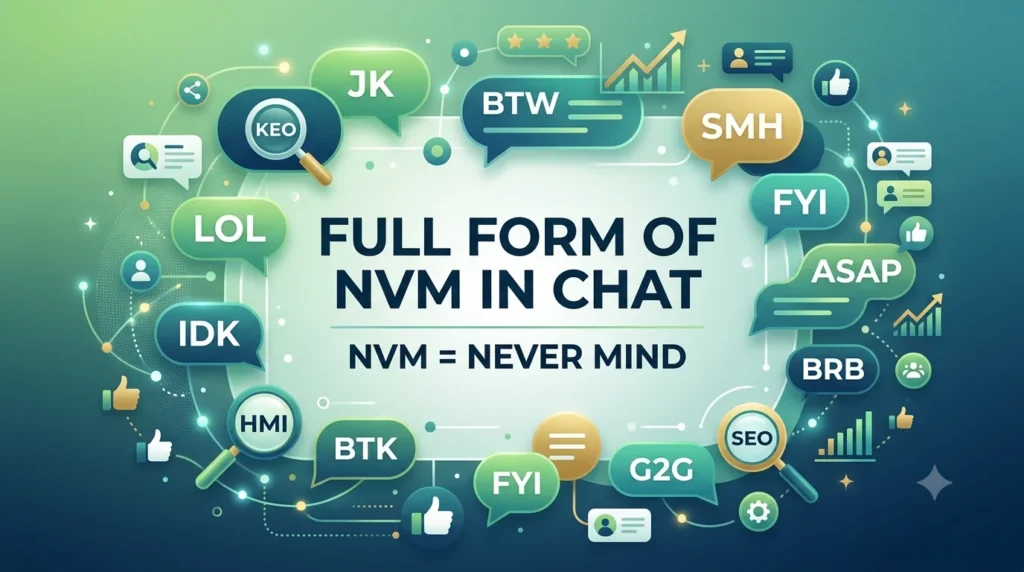
Digital text strips away our vocal inflections, leaving punctuation and abbreviations to do the heavy lifting of human emotion. Among these shorthand tools, the full form of nvm in chat—”never mind”—has quietly evolved from a simple typing shortcut into a major psychological safety valve. Originally created to save keystrokes on old phone keypads, it now functions as a quick way to manage social tension, retreat from minor conversational awkwardness, or signal a shift in attention.
People type it when they realize a question they asked is no longer relevant, or when explaining a complex thought feels like too much work. It gracefully bridges the gap between what we want to say and the energy we actually have to say it. At its core, the phrase is a linguistic reset button, allowing us to withdraw a statement without making a formal scene.
Behind the Screen: Natural Everyday Examples
Texting culture thrives on subtle subtext, meaning a single phrase can mean three different things depending on the platform. The following realistic chat logs showcase how the full form of nvm in chat shifts its emotional weight based on where it appears.
The TikTok Comment Thread
User A: Wait, what song is playing in the background of this video?? It sounds so familiar.
User B: It’s literally tagged at the bottom left of the screen bro 😂
User A: Oh structural blindness strikes again lol nvm found it!
Subtext: Here, the phrase serves as self-deprecating humor. User A uses it to quickly diffuse their own minor embarrassment after missing an obvious detail.
The Instagram DM
Friend 1: Hey are we still on for coffee at 4? I’m running a tiny bit late.
Friend 2: I actually just got caught up in a family thing, can we push to tomorrow?
Friend 1: Oh, nvm then! Tomorrow works much better for me anyway.
Subtext: In this private space, the phrase acts as an emotional cushion. It ensures Friend 2 doesn’t feel guilty for canceling, keeping the vibe relaxed and friction-free.
The Urgent Group Chat
Roommate A: Did anyone take my keys from the kitchen counter? I’m panicking, I’m going to be late for work.
Roommate B: I’m at the library, definitely didn’t touch them.
Roommate A: nvm found them in my jacket pocket false alarm!
Subtext: This is the classic utilitarian use of the phrase. It instantly halts a unfolding crisis and saves everyone from wasting further time or mental energy.
The Subtle Art of Context: Where It Works (And Where It Fails)
Social Spheres and Close Ties
Among friends and peers, using the full form of nvm in chat is as natural as breathing. It signals comfort, intimacy, and shared understanding, letting you drop a conversational thread without explanation. Because close friends already understand your baseline personality, they are highly unlikely to misinterpret a quick lowercase “nvm” as a sign of anger or passive-aggression.
Professional Guardrails
Workplace environments require a completely different linguistic approach. Dropping a casual “nvm” in a Slack channel, a Microsoft Teams thread, or a formal email can easily look dismissive, lazy, or quietly resentful. If a manager asks for an update and you reply with “nvm, handled it,” the brevity might imply you found their inquiry annoying or unnecessary.
Common Friction Points and Misinterpretations
The greatest risk of this digital shorthand lies in generational differences and punctuation choices. Older generations often interpret “never mind” quite literally, assuming a task or topic is fully resolved. Younger digital natives, however, frequently use it to mask minor frustrations or avoid feeling like a social burden.
Punctuation changes the entire emotional landscape of the phrase. A standalone, lowercase nvm feels breezy and casual. On the other hand, typing a capitalized NVM. with a strict period at the end often reads as digital slamming of a door, signaling that the writer is annoyed and shutting down the conversation entirely.
| Term / Slang | Core Meaning | Primary Emotional Vibe |
| NVM (Never mind) | Disregard what was previously stated or asked. | Casual retreat, self-correction, or mild avoidance. |
| JK (Just kidding) | The previous statement was a joke or not serious. | Playful, lighthearted, diffusing potential offense. |
| DW (Don’t worry) | Reassuring the recipient not to stress over an issue. | Supportive, comforting, actively removing anxiety. |
Key Insight
While “JK” reframes a statement as humor and “DW” actively protects the other person’s peace of mind, “NVM” centers entirely on withdrawing your own conversational footprint.
A Field Guide to Responding
Knowing how to reply to this phrase keeps conversations moving smoothly without letting minor misunderstandings linger.
- The Casual Reply: “All good!” or “No worries at all.” (Perfect for closing out simple, everyday self-corrections.)
- The Funny Reply: “Too late, I am already deeply invested in this mystery.” (Great for teasing a friend who tries to pull back a juicy story.)
- The Mature Reply: “Are you sure? I don’t mind helping out if you still need it.” (Ideal when you suspect someone used the phrase because they felt like they were being a nuisance.)
- The Respectful Reply: “Understood. Let me know if it comes up again later.” (The safest option for semi-professional settings or distant acquaintances.)
The Global Lifecycle of Digital Slang
Internet abbreviations have evolved into a borderless language, but local cultural norms still shape how they are received. In Western internet culture and text shortcuts are heavily integrated into daily life therefore functioning as standard tools for social efficiency.
and,
In contrast, many Asian and Middle Eastern cultures place a deep emphasis on relational harmony and explicit politeness in text communication and,
morover,
In these spaces, a abrupt abbreviation can feel overly blunt or disrespectful, leading younger speakers to pair the phrase with soft emojis or expressive exclamation marks to soften the blow.
Generational divides further complicate this global landscape. Gen Z treats lowercase text shortcuts as a fluid way to convey tone and emotional state. Millennials, having witnessed the birth of texting, tend to treat them as simple efficiency tools, while older generations often prefer spelling out the phrase entirely to avoid looking unprofessional.
Is It Safe for Kids?
The full form of nvm in chat is entirely safe for children to use. It carries zero inherently inappropriate meanings, adult themes, or malicious subtext. Parents should simply view it as standard modern digital literacy, though it can offer a good opening to discuss how text formatting and abrupt phrasing can accidentally impact a friend’s feelings.
Frequently Asked Questions
What does NVM mean in modern text messages?
NVM is the standard digital abbreviation for “never mind.” It is used to tell the recipient to ignore a previous message, question, or thought because it is no longer relevant or necessary to discuss.
Is using NVM considered rude in a text?
It depends entirely on the punctuation and context. While a casual lowercase “nvm” among friends is perfectly fine, typing “NVM.” with a period can feel sharp, cold, or passive-aggressive to the reader.
How do you use NVM properly at work?
It is generally best to avoid the abbreviation in professional settings. Instead of typing “nvm,” write out a complete, polite phrase like “Please disregard my previous note, I managed to find the solution.”
Why do people say NVM when they are frustrated?
People sometimes use it as a defense mechanism to shut down a conversation when they feel misunderstood, ignored, or too exhausted to explain their thoughts further.
What is the difference between NVM and NM?
NVM stands for “never mind,” which asks someone to disregard a topic. NM typically stands for “not much,” which is used as a standard response to the question “What’s up?”
Embracing the Evolution of Language
Language has never been static, and our digital shortcuts are living proof of our adaptability. Texting requires us to fit complex, real-time human emotions into tiny glass screens, and phrases like “never mind” give us the space to stumble, self-correct, and change our minds without shame. By understanding the subtle psychology behind these three little letters, we can communicate with greater empathy, clarity, and genuine human connection.