
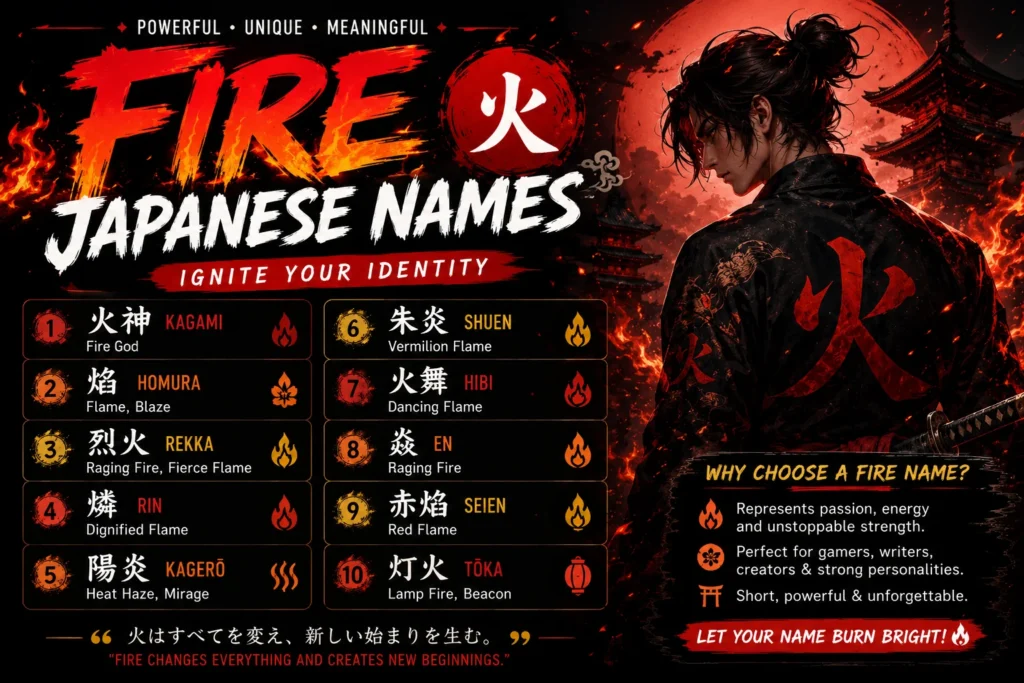
Fire Japanese Names: Powerful Choices With Real Meaning
Fire Japanese names are names inspired by flames, heat, sunlight, burning energy, and the symbolic power of fire. In Japanese, meanings depend heavily on the kanji used to write a name, so two names with similar pronunciations can carry completely different meanings.
Some fire-related choices are direct. Homura (焔/炎) can mean “flame,” while Hinoko (火の粉) means “spark” or literally flying sparks from a fire. Others connect more subtly with brightness, the sun, warmth, or glowing light.
People often search for Japanese fire names for characters, gaming usernames, anime-inspired identities, stories, or baby-name inspiration. The key is distinguishing names that genuinely work as Japanese personal names from dramatic Japanese words that simply sound good as fictional names.
Fire Japanese Names – Quick Meaning
Japanese fire-inspired names can draw meaning from several concepts:
- 火 (hi/ka) — fire
- 炎 (honō) — flame, blaze
- 焔 (homura) — flame
- 灯 (hi/tō/akari) — light, lamp
- 陽 (yō/hi/haru) — sun, sunlight, positive warmth
- 日 (hi/nichi) — sun or day
- 明 (aki/akira) — brightness
- 光 (hikari/kō) — light
- 輝 (ki/kagayaki) — radiance or brilliance
- 灼 (shaku) — burning or scorching
Japanese naming is more complex than simply translating an English word into kanji. Pronunciation, acceptable name readings, gender associations, and cultural familiarity all matter.
Homura (焔) — “Flame”
Akari (灯/明里) — can evoke “light” or brightness depending on kanji
Hikaru (光/輝) — “Light,” “radiance,” or “shine,” depending on the spelling
Origin & Background of Japanese Fire Names
Fire in Japanese Culture
Fire has carried practical, spiritual, and symbolic importance throughout Japanese history.
It can represent destruction, but it also provides warmth, food, purification, protection, and light. This dual character makes fire especially powerful in storytelling.
Traditional festivals involving fire further reinforce its cultural presence. Fire can mark purification, celebration, seasonal change, or religious ritual depending on the tradition.
Why Fire Names Are Popular Online
Anime, manga, video games, and Japanese-inspired fantasy have made fire-themed Japanese words internationally recognizable.
A fictional warrior named Homura, for example, immediately creates an image of intensity and flame for someone who knows the word.
However, fictional naming conventions are often more dramatic than everyday Japanese naming.
That distinction matters when choosing a name for a real person versus an RPG character.
Real-Life Conversations About Fire Japanese Names
WhatsApp Conversation
Person A: I need a Japanese name for my fire character.
Person B: What kind of character?
and,
Person A: Quiet normally, terrifying when angry.
Person B: Homura would fit that energy.
moreover,
Person A: Exactly what I wanted 🔥
Here, Homura works because its flame association matches the character’s personality.
Instagram DM
Person A: Is Akari a fire name?
and,
Person B: More like light or brightness depending on the kanji.
moreover,
Person A: That’s actually better. I don’t want something too obvious.
Person B: Then it fits perfectly.
This illustrates why indirect fire imagery can sometimes create a more natural name.
TikTok Comments
Person A: Everyone uses Japanese names without checking the kanji 😭
Person B: Literally. Same pronunciation can have different meanings.
Person A: Always check the spelling before claiming a meaning.
This is important advice. Japanese names cannot always be accurately defined from romanized spelling alone.
Text Conversation
Person A: I want something that means powerful like fire but doesn’t literally mean flame.
Person B: Maybe something based on sunlight or radiance?
and,
Person A: Yeah, something warmer.
Person B: Hikaru could be worth considering.
Here, “fire” represents energy and brightness rather than literal flames.
Emotional & Symbolic Meaning of Fire Japanese Names
What Fire Represents
Fire names appeal to people because fire contains contradictions.
It can destroy something within minutes, yet humans depend on it for warmth and survival.
Psychologically, that makes fire a strong metaphor for:
- Courage
- Passion
- Anger
- Transformation
- Rebirth
- Determination
- Energy
- Warmth
- Leadership
- Danger
Imagine creating a character who begins timid and uncertain but gradually becomes the person who protects everyone else.
Calling that character something connected with light, flame, or the rising sun can reinforce the character arc without explicitly explaining it.
A good name becomes part of the storytelling.
Fire Japanese Names for Different Contexts
Japanese Fire Names for Anime Characters
Fiction gives you more freedom to use dramatic fire-related words.
Strong options include:
- Homura
- Enka
- Kagaribi
- Hinoko
- Hikari
- Akari
- Hikaru
- Asahi
- Hinata
- Kagayaki
Not all of these are equally conventional as real personal names. Some work better as character names, aliases, or symbolic titles.
Fire Names for Gaming
Short names usually perform better as gamertags.
Examples include:
- Homura
- Enjin
- Kaji
- Kasai
- Hono
- Akari
- Hikaru
- Enka
- Kagero
- Rengoku
Be aware that some of these are ordinary Japanese vocabulary words or surnames rather than conventional given names.
Fire Names for Stories
Writers can choose between literal and symbolic approaches.
A fire mage could have an obvious flame-inspired name.
A subtler character might have a name associated with sunlight, dawn, brightness, or warmth, allowing the symbolism to emerge gradually.
Names for Real People
Extra care is necessary here.
A Japanese word that sounds impressive to an English speaker may sound unnatural as a personal name to a native Japanese speaker.
If choosing a real Japanese given name, verify the exact kanji, reading, naming conventions, and intended meaning.
When NOT to Use a Japanese Fire Name
Don’t select a random Japanese word merely because an online list calls it a “name.”
Hi (火) genuinely means fire, for instance, but knowing the Japanese word for fire doesn’t automatically make “Hi” a conventional Japanese given name.
Similarly, Kasai (火災) means “fire” in the sense of a destructive fire or fire disaster. That makes it dramatically different from a beautiful personal name meaning “flame.”
Context matters.
Also avoid combining random kanji solely because their English translations sound impressive. Japanese characters have readings and cultural associations that don’t always translate cleanly.
For fictional characters, creativity is welcome. For real-world naming, linguistic authenticity deserves more attention.
Common Misunderstandings About Japanese Fire Names
“Hi Is a Japanese Name Meaning Fire”
Hi (火) means fire as a Japanese word.
That does not mean it functions naturally as an ordinary given name.
“Kasai Is a Beautiful Word for Flame”
Not quite.
火災 (kasai) refers to a fire or conflagration, particularly a destructive incident. It would create a very different impression from “warm flame.”
“Every Name Has One Meaning”
Japanese names often have multiple possible kanji spellings.
That means pronunciation alone may not tell you the intended meaning.
“Anime Names Are Always Normal Japanese Names”
No.
Anime and manga creators can intentionally choose unusual, symbolic, pun-based, or highly dramatic names.
“Fire Names Must Contain 火”
They don’t.
Sunlight, brightness, warmth, radiance, dawn, and light can all create fire-like symbolism without directly using the kanji for fire.
Japanese Fire Names Comparison Table
| Name/Word | Japanese | Approximate Meaning | Best Use |
|---|---|---|---|
| Homura | 焔 / 炎 | Flame | Character/name inspiration |
| Akari | 灯 / other kanji | Light | Given name |
| Hikaru | 光 / 輝 | Light, shine | Given name |
| Hikari | 光 | Light | Given name/character |
| Asahi | 朝日 | Morning sun | Given name |
| Hinata | 日向 | Sunny place | Given name |
| Hinoko | 火の粉 | Spark | Fictional name/title |
| Honō | 炎 | Flame | Word/title |
| Kagaribi | 篝火 | Bonfire/watch fire | Fantasy/title |
| Kasai | 火災 | Destructive fire | Word, not ideal as a fire-themed given name |
Key Insight
The best fire Japanese names don’t necessarily translate literally as “fire.” Authentic names associated with light, sun, warmth, brightness, and radiance can communicate fiery energy while sounding much more natural as personal names.
10 Types of Japanese Fire-Inspired Names
1. Homura
Meaning: Flame.
A dramatic choice with direct fire imagery, particularly effective for fictional characters.
2. Akari
Meaning: Light or brightness with certain kanji.
Akari has a warm, gentle feeling rather than an aggressive fire association.
3. Hikaru
Meaning: Light, radiance, or shine depending on kanji.
A strong option when you want fiery brightness without literal flames.
4. Hikari
Meaning: Light.
Hikari creates associations with hope, illumination, and positive energy.
5. Asahi
Meaning: Morning sun.
It evokes sunrise, warmth, renewal, and the beginning of a new day.
6. Hinata
Meaning: Often associated with a sunny place or being in the sun, depending on kanji.
The name feels warm and bright rather than destructive.
7. Hinoko
Meaning: Spark.
火の粉 literally refers to sparks or flying embers. It works particularly well as creative character inspiration.
8. Kagaribi
Meaning: Bonfire or watch fire.
This is much more suitable as a poetic title, fantasy alias, or fictional concept than a typical everyday given name.
9. Honō
Meaning: Flame.
炎 is the ordinary Japanese word for flame or blaze. It works strongly as a symbolic word but isn’t automatically a conventional personal name.
10. Kagayaki
Meaning: Radiance, brilliance, or shine.
It captures the visual energy of fire through brightness rather than literal burning.
100+ Fire Japanese Name Ideas
Powerful Fire-Inspired Names
- Homura
- Hikaru
- Hikari
- Akari
- Asahi
- Hinata
- Akira
- Haruhi
- Teru
- Kōki
- Kōsei
- Akito
- Haruto
- Hinako
- Akihiko
- Akihito
- Teruki
- Mitsuaki
- Mitsuteru
- Kōtarō
Fire Names for Boys
- Hikaru
- Asahi
- Haruto
- Akito
- Akihiko
- Akira
- Teru
- Teruki
- Kōki
- Kōsei
- Hinata
- Haruhi
- Mitsuaki
- Akihito
- Kōta
- Haruaki
- Teruaki
- Mitsuteru
- Akimitsu
- Kōtarō
Fire Names for Girls
- Akari
- Hikari
- Hinata
- Hinako
- Akira
- Haruhi
- Hina
- Asahi
- Terumi
- Akemi
- Aki
- Mitsuki
- Hiyori
- Koharu
- Himari
- Haruka
- Haruna
- Akina
- Akiko
- Teruko
Fantasy Fire Names
These are better treated as creative names, aliases, or titles rather than guaranteed conventional Japanese given names:
- Homura
- Honō
- Hinoko
- Kagaribi
- Enka
- Kagerō
- Enjin
- Shakunetsu
- Gōka
- Kaen
- Rekka
- Enbu
- Ennetsu
- Akatsuki
- Kagayaki
- Shinka
- Engetsu
- Hien
- Kōen
- Rengoku
Short Japanese-Inspired Fire Names
- Aki
- Hina
- Haru
- Teru
- Kō
- Akira
- Akari
- Hikaru
- Hikari
- Asahi
- Hinata
- Homura
- Hiyori
- Akito
- Hinako
- Kōki
- Haruhi
- Teruki
- Akemi
- Koharu
Availability and exact meanings depend on the chosen kanji, so these should be researched individually before real-world naming.
How to Respond When Someone Uses a Japanese Fire Name
Casual Replies
“That’s a powerful name.”
“What kanji are you using?”
“I like the fire symbolism.”
“Homura sounds intense 🔥”
Funny Replies
“Bro named the final boss already 😂”
“That character definitely has a fire ultimate.”
“Sounds like someone is about to unlock a transformation 🔥”
Mature Replies
“What meaning are you aiming for?”
“Check the kanji before deciding.”
“Is this for a real person or fictional character?”
Respectful Replies
When someone chooses a Japanese name, focus on its intended meaning while respecting the language behind it.
Asking about the kanji is often more meaningful than assuming a definition from the romanized spelling.
Regional & Cultural Usage
Japanese Context
Japanese personal names are deeply connected to kanji.
Parents may consider meaning, pronunciation, visual appearance, associations, and naming conventions when choosing characters.
This makes Japanese naming much richer than direct English translation lists suggest.
Western Culture
Western audiences often discover Japanese fire names through anime, manga, gaming, martial arts, and Japanese popular culture.
As a result, dramatic words such as “flame” may be especially attractive for fictional characters.
Asian Pop Culture
Japanese entertainment has significant influence across many Asian markets.
Fire-themed characters are often associated with courage, combat ability, passion, leadership, or explosive personalities.
Global Gaming Culture
Japanese-inspired usernames are popular in games because short Japanese words can sound distinctive internationally.
Still, using a real word correctly is better than selecting something purely because it “sounds Japanese.”
Generational Differences
Younger audiences are more likely to encounter Japanese names through anime, TikTok edits, games, and online fandoms.
Older audiences may encounter them through literature, history, traditional arts, business, or personal relationships.
Both routes can produce very different ideas of what sounds authentically Japanese.
Are Japanese Fire Names Safe for Kids?
Yes. Fire-inspired Japanese names are generally harmless.
For fictional characters or gaming profiles, names associated with flames, sunlight, brightness, and warmth can be creative and empowering.
For an actual child’s name, however, parents should verify the kanji and reading with a knowledgeable Japanese speaker or naming authority. A translated word that looks beautiful on an English website may not function naturally as a Japanese personal name.
FAQs About Fire Japanese Names
What Japanese name means fire?
Homura (焔/炎) is strongly associated with “flame.” However, not every Japanese word meaning fire is naturally used as a personal name.
What Japanese name means flame?
Homura can mean “flame” and is one of the strongest direct choices for a fire-themed fictional or symbolic name.
What Japanese name means light?
Hikari (光) means “light.” Hikaru can also be written with kanji associated with light, shining, or radiance.
What Japanese name is associated with the sun?
Asahi (朝日) means “morning sun,” while names using characters such as 日 and 陽 can carry associations with sunlight or warmth.
Is Kasai a Japanese name meaning fire?
Kasai (火災) means a destructive fire or conflagration as a Japanese word. It should not simply be presented as a beautiful personal name meaning “fire.”
What is a cool Japanese fire name for a boy?
Hikaru, Asahi, Haruto, Akito, Akira, and Hinata can provide bright, warm, or sun-associated inspiration depending on their kanji.
What is a beautiful Japanese fire name for a girl?
Akari, Hikari, Hinata, Hinako, Akemi, and Haruhi offer softer associations with light, sunshine, or brightness depending on their written forms.
Conclusion
Choosing fire Japanese names becomes much more interesting when you look beyond a literal translation of “fire.”
Homura provides powerful flame imagery, while names such as Akari, Hikari, Hikaru, Asahi, and Hinata can express related ideas of light, warmth, sunshine, and radiance.
For anime characters, games, and fantasy stories, dramatic words such as Hinoko, Kagaribi, Kaen, and Honō can provide even stronger imagery. For real personal names, authenticity matters more: always verify the exact kanji, pronunciation, and cultural suitability.
Fire can represent destruction, but it can also represent warmth, courage, transformation, and the light that remains when everything around it is dark. That deeper symbolism is what makes a well-chosen fire-inspired name memorable.