If you spent any time on the internet during the late nineties or early 2000s, you likely remember entering an IRC channel or an AOL chatroom and being instantly greeted with three simple letters.
Back then, the standard icy-breaker was a rapid-fire request for your basic identity markers.
Fast forward to the modern digital landscape, and those same three letters have suddenly resurfaced in TikTok captions, Instagram direct messages, and viral tweets.
However, the way people use this shorthand today has shifted beautifully, leaving many seasoned internet users feeling entirely out of the loop.
Decoding the Language Shift on Our Screens
Digital text moves at a blistering pace, forcing words to adapt or risk total extinction. Because text-based conversations lack physical cues, a single acronym can completely change its identity across different decades and platforms.
Thousands of curious users search online for the true asl meaning in chat every single day. They are often caught between an old-school internet definition and a brand-new cultural phenomenon.
Resolving this common misunderstanding protects you from making awkward assumptions in your daily chats. It bridges the gap between different generations of internet culture, turning digital confusion into smooth, confident connection.
Asl Meaning in Chat – Quick Meaning
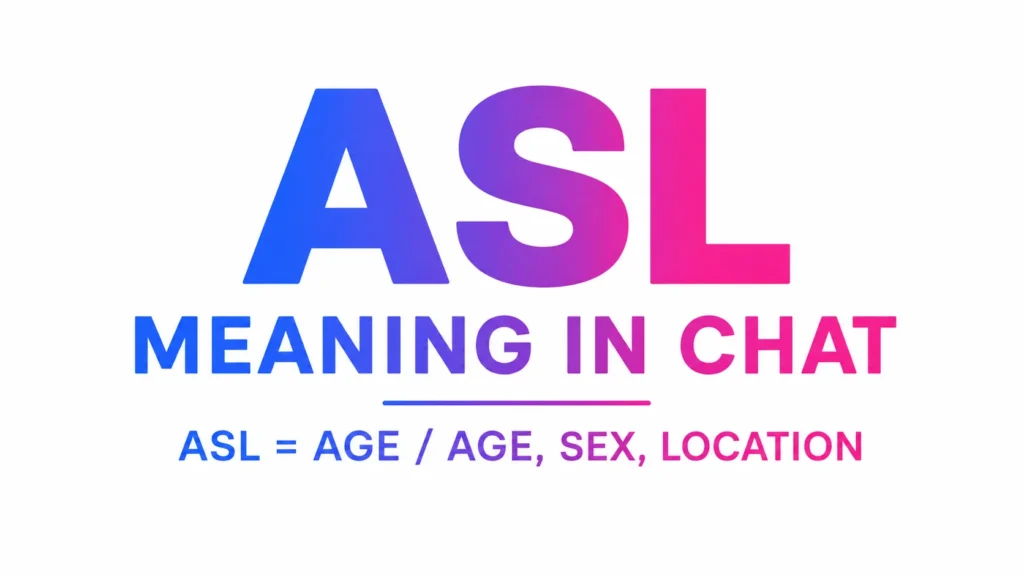
Depending entirely on the age of the person you are texting, this acronym serves two completely dominant, separate functions.
- Classic Era Meaning: Age, Sex, Location (A request for demographic details).
- Modern Era Meaning: “As hell” (A phonetic, stylized intensifier used for deep emphasis).
- Alternative Cultural Meaning: American Sign Language (When discussing accessibility or linguistics).
“Hey there! Welcome to the group. Asl?”
“That final exam was difficult asl, I honestly don’t think I passed it.”
“I am currently taking an online course to learn basic ASL so I can communicate with my cousin.”
Origin & Background
The historical trajectory of this acronym feels like a wild ride through the changing architecture of the internet itself.
The Era of Anonymous Chatrooms
During the dawn of consumer internet platforms like mIRC, ICQ, and AOL Instant Messenger, anonymity was the default state of being. Users were hidden behind cryptic handles like SkaterBoy99 or StarryNight.
To kickstart a conversation with a total stranger, you needed a fast baseline. The question “Age, Sex, Location?” was quickly condensed into a three-letter command to screen potential conversation partners instantly.
The Social Media Phonetic Revolution
As the internet shifted toward identity-verified platforms like Instagram and TikTok, the original demographic request lost its purpose. People already had their ages, faces, and locations pinned directly to their public profiles.
Instead of dying out, the acronym found a second life within Black American English and urban internet spaces. Younger creators began using it as a phonetic shortcut for the phrase “as hell,” matching the natural rhythm of spoken slang.
Real-Life Conversations
To truly appreciate how this linguistic chameleon operates in the wild, let us observe it across a few authentic modern message exchanges.
WhatsApp Exchange
Person A: Are you still planning on coming to the gym with me tonight?
and,
Person B: Man, I want to, but I am tired asl after pulling that double shift at the restaurant.
moreover,
Person A: Totally understand, go get some sleep and we will hit the weights tomorrow instead!
Instagram DMs
Person A: Look at this throwback photo I found of us from middle school!
and,
Person B: Oh my god, stop, that is funny asl 😭 Why did we think those haircuts looked good?
moreover,
Person A: We genuinely thought we were the coolest kids in school!
TikTok Comments
Person A: Wait, is the creator in this video actually using sign language or just doing random hand movements?
Person B: She is deaf! She is using ASL to explain the lyrics of the background song to her followers.
Person A: Wow, that is beautiful, thanks for clarifying!
Text Messages
Person A: Hey, I found an old hard drive with chat logs from our old gaming clan back in 2004.
Person B: No way! Let me guess, every single conversation started with someone asking “asl?” within five seconds?
Person A: Literally every single one, it feels like looking into a ancient time capsule.
Emotional & Psychological Meaning
Beneath its abbreviated surface, using this phrase reveals our deep psychological need for social belonging and linguistic efficiency.
When a modern text user appends these letters to an adjective, they are seeking validation for an extreme emotional state. It amplifies a feeling without requiring the formal weight of traditional punctuation.
In contrast, the historical usage of the phrase represented a basic human drive to reduce uncertainty. When interacting with an amorphous wall of text in a nineties chatroom, the brain desperately craved a physical framework to visualize the person on the other side.
A Real-Life Scenario
Imagine a young college student, Marcus, who just spent twelve hours straight finishing his final architecture portfolio. His eyes are bloodshot, his hands are shaking from caffeine, and he feels completely drained.
Instead of writing a formal essay to his best friend about his physical exhaustion, he sends a text: “I am tired asl.”
This short phrase communicates a raw, unfiltered state of being. It allows his friend to instantly step into his shoes and offer immediate emotional support without forcing Marcus to waste precious energy on complex syntax.
Usage in Different Contexts
Recognizing your digital environment is the ultimate key to determining which version of the acronym is sitting in front of your eyes.
Social Media
On platforms dominated by Gen Z and Alpha, the term is almost exclusively used as an intensifier. Seeing it in a video caption like “cute asl” means the user finds the subject incredibly attractive or endearing.
Friends & Relationships
Among close friends, using the modern phonetic version adds a layer of casual, comfortable warmth to your daily banter. It signals that you are communicating in an unstructured, safe social zone.
Work & Professional Settings
In professional emails or workplace channels like Slack, these three letters should remain completely absent. Using them as slang looks deeply unprofessional, while using the historical demographic definition could violate workplace boundaries.
Casual vs. Serious Tone
The modern version belongs strictly in casual, low-stakes conversations. Dropping it into a highly sensitive, serious emotional discussion can make you look immature or detached from the gravity of the situation.
When NOT to Use It
While shorthand keeps our thumbs happy, certain clear boundaries require you to drop the slang to protect your relationships.
Formal Professional Projects
Never allow internet abbreviations to slip into corporate presentations, cover letters, or academic papers. It immediately breaks the standard rules of professional etiquette and damages your intellectual authority.
High-Stakes Emotional Apologies
If you are trying to repair a broken trust or apologize for a major mistake, keep your language clean and fully spelled out. Using shortcuts makes your expression of remorse look insincere and rushed.
Medical and Legal Correspondence
When communicating with healthcare providers or legal counsel, clarity is paramount. Any use of internet jargon can obscure vital information and cause highly dangerous misunderstandings.
Slang Comparison Index
| Expression | Alternate Slang | Primary Function | Emotional Undercurrent |
| Asl (Modern) | Af / Asf | Intensifying an adjective | High energy / Emphasis |
| Asl (Classic) | Whu (Where have you been) | Seeking identification | Curiosity / Screening |
| ASL (Linguistic) | BSL / Auslan | Cultural communication | Inclusion / Accessibility |
Key Insight
While modern shortcuts like “af” serve a nearly identical grammatical purpose, this specific acronym carries a slightly more melodic, spoken cadence that mirrors natural urban speech patterns.
Variations & Types
The layout and capitalization of these three letters completely dictate how a recipient decodes their underlying message.
IT and Lowercase, Modern Text
- Meaning: As hell.
- Explanation: Used at the absolute end of a sentence to inject intense emphasis into a preceding descriptor.
IT and All Caps, Modern Text
- Meaning: American Sign Language.
- Explanation: The standard, formal acronym honoring the rich visual language used by the Deaf community.
Asl? (Question Mark attached)
- Meaning: Age, Sex, Location?
- Explanation: The definitive retro format used to demand basic background details from a stranger online.
asl af
- Meaning: As hell, as f***.
- Explanation: A double intensifier used by younger speakers to express an completely overwhelming level of an emotion.
cute asl
- Meaning: Incredibly attractive or charming.
- Explanation: A highly common compliment found written across modern Instagram comment sections and TikTok stitch videos.
funny asl
- Meaning: Absolutely hilarious.
- Explanation: Used to show that a specific piece of digital media caused the user to laugh out loud in real life.
mad asl
- Meaning: Extremely angry or frustrated.
- Explanation: Signals that a specific real-world event has pushed the sender’s patience to its absolute limit.
basic asl
- Meaning: Extremely simple or unoriginal.
- Explanation: A critical descriptor used to call out something that feels entirely mainstream or uninspired.
How to Respond When Someone Uses It
Your reply should seamlessly match the specific generational era and emotional tone of the message you received.
Casual Replies
“Right? I completely agree with you on that.”
“Haha, couldn’t have said it better myself.”
Funny Replies
“As hell? Sir, please watch your digital language in this household!”
“You are old-school asl for even using that phrase right now!”
Mature Replies
“It sounds like you are dealing with a lot of stress right now. Let me know if you want to chat.”
“I can see how deeply that affected you. Let’s take a break and look at it tomorrow.”
Respectful Replies
“Thank you for sharing your perspective with me.”
“Got it, thanks for giving me a clear heads-up on how you feel.”
Regional & Cultural Usage
Geographic boundaries and generational dividing lines radically alter how these three letters are processed around the globe.
Western Culture
In North America, the phrase is deeply bifurcated. Major metropolitan areas and younger demographics lean entirely toward the phonetic intensifier, while older internet users still associate it with desktop computing in the nineties.
Global Internet Usage
In international regions where English is a second language, the classic chatroom definition often persists longer because it was hardcoded into early global internet dictionaries.
Generational Differences
Gen Z views lowercase text as a playground for phonetic style, using the acronym without a second thought to mean “as hell.”
Conversely, Gen X and Millennials might instantly view the phrase as an intrusive, old-school invasion of privacy, proving how vital cultural context truly is.
Is It Safe for Kids?
Parents reviewing their children’s devices can remain relatively calm when encountering this abbreviation. In its modern context, it functions merely as a slightly edgy emphasis tool, akin to saying something is “amazing hot” or “Extremely difficult.”
However, because it phonetically mimics a mild swear word, parents should look at the surrounding conversation to ensure the tone remains healthy, safe, and respectful.
Frequently Asked Questions
Does asl mean “age, sex, location” or “as hell”?
It means both. Older generations use it to ask for demographic details, while younger generations use it to mean “as hell.”
Why do people on TikTok write “cute asl”?
They are using it as a high-energy compliment that translates directly to “cute as hell.”
Is using asl offensive?
It is not inherently offensive, though it mimics a mild expletive, making it inappropriate for formal or polite company.
What does ASL mean in terms of accessibility?
It stands for American Sign Language, a complete, complex visual language used primarily by deaf individuals in North America.
How do I know which meaning of asl someone intends?
Look for a question mark. If it says “asl?”, it is a demographic question. If it follows an adjective like “cold asl,” it means “as hell.”
Conclusion
Our spoken and written language is an ever-changing mirror of how we interact with our technology and each other. The surprising evolution of the asl meaning in chat proves that words will always find a way to reinvent themselves to serve our shifting emotional needs.
Whether you are reminiscing about the nostalgic days of desktop chatrooms, learning a beautiful visual language, or simply matching the vibrant energy of younger creators, understanding these shifts makes you a more empathetic human.
Step out into your digital circles with this newfound clarity, and enjoy the beautiful, evolving tapestry of modern human speech.